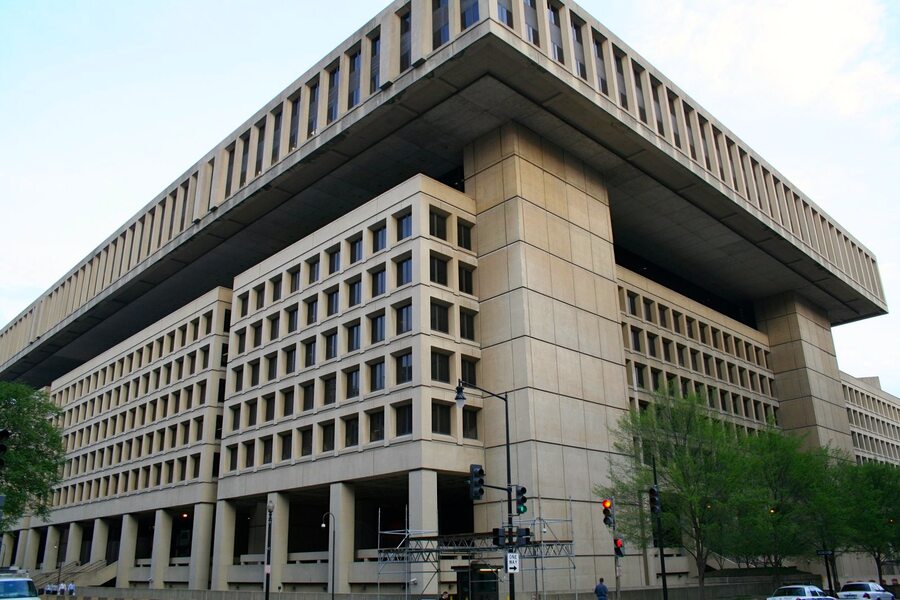
FBI Headquarters, Washington D.C. The Bureau confirmed it is leading a formal review of deaths and disappearances involving staff at sensitive U.S. research facilities. Source: Wikimedia Commons / public domain.
Investigation
The Missing Scientists: Eleven Deaths and Disappearances That Have the FBI Investigating
Since 2022, eleven scientists, engineers, and specialists connected to America’s most sensitive defence and research facilities have died or disappeared under circumstances that remain, in several cases, formally unexplained. The FBI is now leading a review to determine whether any connections exist. The UAP community has noticed. Here is what the evidence actually shows — and what it does not.
The UFO Times · Editorial
Government Files · Investigation · Updated June 2026
In the spring of 2026, a story that had been circulating in UAP disclosure circles for months broke into mainstream media: a cluster of deaths and disappearances involving scientists, engineers, and administrators connected to America’s most sensitive research institutions. The FBI confirmed it was reviewing the cases. Congress launched a formal probe. And the UAP community — already primed by years of whistleblower testimony, Pentagon file releases, and classified-programme revelations — began asking the question that governments have so far declined to answer: is this a pattern, or a coincidence?
As of June 2026, eleven individuals have been named in what researchers are calling the “missing scientists” list. Their backgrounds span Air Force research, nuclear-weapons development, NASA programmes, fusion science, and national-security campus administration. Several worked at institutions — Los Alamos, Sandia, Lawrence Livermore, Jet Propulsion Laboratory — that have historically been linked to the most classified layers of U.S. aerospace and defence research. Some of those institutions have, in recent years, been named in the context of UAP reverse-engineering claims.
The FBI has not said these deaths are connected. It has not said they are connected to UFOs. What it has said is that the pattern is unusual enough to warrant formal federal review. That is, for an institution not given to unnecessary alarm, a significant statement.
The Case That Started Everything: Neil McCasland
Maj. Gen. William Neil McCasland, seventh Commander of the Air Force Research Laboratory. Reported missing February 27, 2026. His whereabouts remain unknown.
The story gained its current momentum on February 27, 2026, when retired U.S. Air Force Major General William Neil McCasland was reported missing by his wife. He was 68 years old. He had last been seen in New Mexico. He has not been found.
McCasland is not a peripheral figure. He served as the seventh Commander of the Air Force Research Laboratory at Wright-Patterson Air Force Base — the facility that has occupied a central place in UAP mythology since the 1947 Roswell incident and the alleged transfer of recovered materials. In retirement, his name appeared in discussions within disclosure circles, including accounts from researchers who claimed he had personal knowledge of classified UAP programmes. His disappearance was therefore not treated as an ordinary missing-persons case. It was treated, at least in the research community, as potentially the most significant disappearance in modern UFO history.
To date, extensive searches have located no trace of him. Law enforcement has not publicly announced evidence of foul play, nor have they provided a cause for his disappearance. His case remains open.
The Air Force Research Laboratory, Wright-Patterson Air Force Base — the facility McCasland commanded. Wright-Patterson has long been at the centre of UAP mythology, cited in accounts of recovered materials dating to the 1947 Roswell incident.
Melissa Casias: The Case That Changed the Tone
If McCasland’s disappearance raised questions, the discovery of Melissa Casias’ remains changed the atmosphere entirely.
Los Alamos National Laboratory, New Mexico — birthplace of the atomic bomb and one of America’s most classified research sites. Melissa Casias worked here as an administrative assistant.
Casias worked as an administrative assistant at Los Alamos National Laboratory — the birthplace of the atomic bomb and one of the United States’ most classified research sites. She disappeared on June 26, 2025, leaving behind her phone and personal belongings. On May 28, 2026, a hiker discovered her remains in a remote section of Carson National Forest in New Mexico. Her body was skeletonised. A handgun was found nearby. A gunshot wound to the skull was noted. The cause of death remains under formal investigation.
Carson National Forest, New Mexico. A hiker discovered Melissa Casias’ skeletonised remains here on May 28, 2026 — nearly a year after she disappeared. The cause of death remains under investigation.
No direct evidence has surfaced connecting Casias to UAP research specifically. Her connection to Los Alamos is the link that places her on the list — a facility that has been named, indirectly, in several accounts of classified American aerospace programmes. Whether that connection is meaningful, coincidental, or entirely irrelevant to the circumstances of her death is not yet known.
The Other Cases
Monica Reza served as a materials processing specialist at NASA’s Jet Propulsion Laboratory, with professional connections to Air Force–funded research projects. She disappeared during a hiking trip and her name has repeatedly appeared alongside McCasland’s in federal reviews. Her case remains among the unexplained.
Steven Garcia worked at the Kansas City National Security Campus, where his responsibilities involved components related to U.S. nuclear-weapons systems — among the most tightly controlled programmes in the American defence establishment. He disappeared in August 2025, last reportedly seen leaving his home on foot. He has not been publicly located.
Nuno Loureiro was a well-regarded fusion scientist whose work was funded through government research channels. His death was incorporated into the broader “missing scientists” discussion because of his advanced research background and institutional connections. No public evidence has established a UFO-related dimension to his case.
Carl Grillmair was a respected astronomer. His case is included here not because it supports the conspiracy narrative, but because it complicates it. Investigators identified a specific suspect and motive entirely unrelated to UAP research. Grillmair’s family has publicly and directly rejected conspiracy claims. His case is a reminder that researchers must be disciplined about grouping unrelated incidents together simply because the individuals shared institutional backgrounds.
The remaining five cases on the Congressional list have not been fully detailed in public reporting as of June 2026. The investigation is ongoing.
Kirtland Air Force Base, Albuquerque, New Mexico — one of several sensitive U.S. defence facilities connected to individuals named in the ongoing federal review.
What the FBI Has — and Has Not — Said
The FBI’s formal involvement is the element of this story that distinguishes it from standard disclosure-community speculation. The Bureau has confirmed it is leading a review to determine whether connections exist between deaths and disappearances involving staff at sensitive government research facilities. NASA and other agencies have reportedly cooperated with the review.
What the FBI has not said is equally important. It has not confirmed a conspiracy. It has not confirmed UFO involvement. It has not announced evidence of foreign intelligence activity, and it has not publicly linked the cases to one another. The Department of Energy, which oversees several of the facilities involved, has also conducted its own internal review.
Congress has gone further. A formal Congressional probe was launched in spring 2026, with elected officials citing the cluster of cases as warranting independent oversight. Several members of Congress have specifically suggested that foreign intelligence services and industrial espionage cannot be ruled out — a framing that is notably different from the UFO hypothesis but equally serious.
Three Theories, One Standard of Evidence
There are three broad explanations currently in circulation, and they are not equally supported by available evidence.
The first is coincidence. Different people, different institutions, different states, different circumstances, different causes of death or disappearance. Humans are pattern-recognition machines, and that faculty — which has served us well evolutionarily — regularly produces false positives when confronted with a cluster of high-profile events. Multiple experts interviewed by mainstream media outlets have noted that, absent specific evidence of coordination, statistical coincidence remains the most parsimonious explanation. This is not a dismissal. It is a methodological standard.
The second theory involves national security and foreign intelligence. If one or more of these individuals had access to genuinely sensitive classified information — about weapons systems, materials research, or aerospace programmes — then foreign intelligence services, specifically those with active human-intelligence operations in the United States, would represent a more conventionally plausible explanation than a domestic cover-up. China and Russia both run sophisticated espionage operations targeting American defence and research institutions. Congressional members who have raised this theory are not UFO believers; they are national security practitioners.
The third theory is the one that drives interest in UAP circles: that some of these individuals possessed knowledge related to classified UAP reverse-engineering programmes — the kind described under oath by David Grusch in 2023, and referenced obliquely in several recently declassified PURSUE files — and were silenced or eliminated because of it. This theory is the most dramatic, the most widely circulated, and the least supported by currently available public evidence. That does not mean it is false. It means it requires evidence to be taken seriously as a conclusion rather than a hypothesis.
Our Assessment
Something unusual is happening. Several high-profile deaths and disappearances involving individuals connected to America’s most sensitive research institutions have attracted formal federal and Congressional attention. That is not nothing. The FBI does not open reviews casually, and Congress does not launch probes for entertainment.
But the evidence currently available does not demonstrate a coordinated campaign, a UAP-related motive, or a disclosure cover-up. It demonstrates a cluster of unexplained cases at a moment when the UAP disclosure story has reached an unprecedented level of public and institutional attention — which creates a powerful interpretive lens through which every anomaly gets refracted.
The story has the potential to become one of the most consequential UAP-adjacent investigations of 2026. What would change that assessment: the location of McCasland, the FBI announcing formal findings, the release of additional classified records linking any of these individuals to specific programmes, or the emergence of credible witnesses with verifiable accounts. Until any of those things happen, the most responsible position is to treat this as what it currently is — a genuinely unresolved mystery with serious institutional attention, rather than confirmed evidence of a conspiracy.
We will update this article as new information becomes available.
Recommended Reading
Whistleblower Account
Imminent
Luis Elizondo — The former director of AATIP on classified UAP programmes, government secrecy, and what he believes the evidence shows.